Your Name Real-Life Locations: Suga Shrine & Itomori
Location Guide · 4 min read
Published July 22, 2026 · Updated August 22, 2026
Your Name (Kimi no Na wa.) takes place in Tokyo and the fictional lakeside town of Itomori, whose scenery Makoto Shinkai modeled on the Hida region of Gifu Prefecture. Taki's half of the film is drawn from real, precisely rendered corners of Shinjuku, Yotsuya, and Roppongi; Mitsuha's Itomori doesn't exist on any map, but its stations, library, and streets were traced from Hida-Furukawa. That split makes Your Name one of Japan's defining anime pilgrimages — Anime Itinerary has verified more than 40 of its locations, each with the exact scene it appears in.
The Suga Shrine stairs: the most famous shot in anime pilgrimage
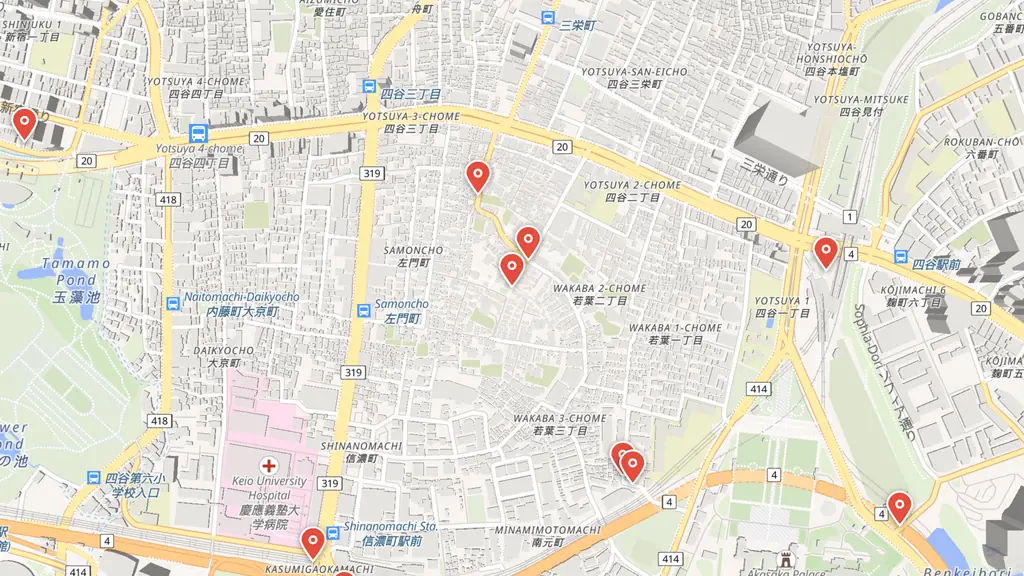
The film's final scene — two people passing on a red-railed staircase — happens on the Otokozaka steps of Suga Shrine in Yotsuya, Tokyo, a few minutes' walk from Yotsuya-sanchome Station. It is probably the single most photographed anime location in Japan, and on any given afternoon you'll find visitors from around the world waiting their turn to recreate the frame. Go early on a weekday for a clear shot, and remember the stairs sit in a quiet residential neighborhood: keep the noise down and don't block residents. The shrine itself deserves a respectful visit too — and if the spot leaves you wanting more shrine pilgrimage, read where to go after Suga Shrine.
Taki's Tokyo
Shinkai reproduces the city almost photographically, and the verified spots cluster into an easy walking day:
- Yotsuya and Shinanomachi — Taki's home turf. Yotsuya Station, the Shinanomachi footbridge with its skyline backdrop, Sendagaya Station, and the sloped backstreets of old Akasaka (Kinokuni-zaka among them) all appear as drawn.
- Shinjuku — the crossings, the station's south exit, and the streets around Shinjuku Gyoen. The Italian restaurant where Taki waits tables was modeled on Cafe La Boheme Shinjuku Gyoen, which fans treat as the canonical lunch stop of the pilgrimage.
- Roppongi — the date with Okudera passes through The National Art Center, Tokyo, whose glass facade and café are instantly recognizable, with the city-view scenes matched to the Roppongi Hills observation deck.
- Shibuya and beyond — Tower Records, the station's pedestrian deck, and Meiji Jingu Gaien fill out the montage shots.
None of these need planning gymnastics: everything sits on or near the JR Yamanote and Chuo-Sobu lines.
Where is Itomori in real life?
Itomori is not a real place — it is a fictional town, and the closest thing to it on a map is Hida-Furukawa in Gifu Prefecture. Shinkai has described the town as a composite rather than a copy: its everyday fabric — the station, the library, the streets Mitsuha walks — was traced from Hida-Furukawa, while the dramatic crater lake it sits beside is most often linked to Lake Suwa in Nagano. Searching for "Itomori" in a mapping app returns nothing; searching for Hida-Furukawa takes you to the scenery.
Itomori is fictional, then, but the town's everyday fabric is unmistakably Hida-Furukawa in Gifu. The verified spots include Hida-Furukawa Station (the film's Itomori station shot matches the platform view), the Hida City Library (a pilgrimage destination so popular the library posts photography rules — always follow them and photograph only where permitted), the Hidashi tourist information center, and the Ochiai bus stop a short ride into the countryside, where the film's rural bus-stop scene was matched. Taki's journey there is drawn from real rail travel too, down to the transfer across platforms 10 and 11 at Nagoya Station.
Hida-Furukawa is about three hours from Nagoya by JR limited express — realistic as a long day trip, better as an overnight in the old town.
Planning a Your Name pilgrimage
The clean split is one Tokyo day and one Hida day. Start from the Your Name real-life locations page to see every verified spot with its scene reference, save the ones you want, and build an optimized route — the Tokyo spots chain together on foot and by Yamanote Line, while the Hida leg is its own trip. If Your Name is your gateway into location-hunting, our primer on what anime pilgrimage (seichi junrei) is covers the etiquette that keeps places like Suga Shrine and the Hida library welcoming, and the full anime map shows what else you can fold into the same trip.
Keep exploring
- After Suga Shrine: Visit Washinomiya Next — you've climbed the stairs and matched the frame; Washinomiya Shrine, the birthplace of modern anime pilgrimage, is under an hour away and shows what a town that embraced its fans looks like.
- 5 Anime Stops You Can Visit in One Tokyo Day — Suga Shrine is one of five iconic locations you can chain into a single Yamanote-line day, with the train segments already worked out.