How Japan's Cherry Blossom Forecast Works
Japan Travel · 5 min read
Published October 15, 2026
Japan's cherry blossom season runs on a forecast, and that forecast does not come from the government. Three private weather companies, Weathernews, the Japan Weather Association and Japan Meteorological Corporation, publish Japan's cherry blossom forecast each spring and revise it as the bloom moves north. In Japanese the forecast is 桜の開花予想, and the advancing line of blossoms is the 桜前線, the cherry blossom front.
This is the second piece in Anime Itinerary's spring series. The first, anime cherry blossom spots in Japan, covers the scenes themselves. This one covers the calendar behind them.
Who publishes Japan's cherry blossom forecast?
The Japan Meteorological Agency, 気象庁, published the forecast for decades. It stopped in 2010 and left the job to private forecasters, who were already doing it. The agency still keeps the official record. Each city has a single sample tree, the 標本木, and the agency's seasonal observation page logs the day that tree blooms.
Five private companies now issue forecasts. Three of them account for most of what travellers read.
Weathernews opens the season. Its first 2026 forecast appeared on 8 January 2026, and a second followed on 28 January. Its spot pages for the 2027 season are scheduled for February 2027.
The Japan Weather Association publishes the sakura pages on tenki.jp, with an English edition. JNTO's own cherry blossom forecast credits it for the 2026 data.
Japan Meteorological Corporation's forecast, also published in English, covers about 1,000 viewing spots between Hokkaido and Kagoshima. Its 2026 cycle ran to 14 rounds, and the last came out on 23 April.
Each company works to its own schedule, and each update can move a city's date. Over a season, the direction of those revisions says more about an early or late spring than any single release does.
What do first bloom and full bloom mean?
開花, kaika, is first bloom. The agency declares it when five or six flowers have opened on a city's sample tree. At that point the branches are still mostly bare.
満開, mankai, is full bloom. It is declared when 80 percent or more of the tree's buds are open. This is the stage most photographs of the season show.
The sample tree is usually a Somei Yoshino, the pale cherry planted across most of the country. Okinawa and Amami track kanhizakura instead, and northern and eastern Hokkaido track Ezo-yamazakura.
Each city's date describes one tree. Tokyo's stands at Yasukuni Shrine. Parks and temples elsewhere in the same city can bloom on different days, and those on higher ground bloom later.
First bloom and full bloom sit about a week apart. In an average year, Tokyo reaches first bloom on 24 March and full bloom on 31 March. Kyoto's averages are 26 March and 4 April. Kofu, the capital of Yamanashi, sits at 25 March and 2 April.
How does the cherry blossom front move?
The front travels south to north, and from low ground to high ground. Okinawa's trees open in January. Kyushu, Shikoku and the large Honshu cities follow in late March and early April. Tohoku comes after them, and Hokkaido is last, with blossoms into May.
JNTO describes the main season as running "from the latter half of March to as late as early May." Over those six weeks the front crosses most of the country, so a single trip can meet it at different stages in different cities.
When does the 2027 forecast come out?
The 2027 forecasts do not exist yet. Weathernews issued its first 2026 forecast on 8 January, and its 2027 spot pages are due in February 2027. Japan Meteorological Corporation's 2026 cycle ran until 23 April, well after the bloom had passed most of Honshu.
Until the first release, the averages above are the only baseline, and they can be well off. In 2026, Kofu reached full bloom on 24 March, nine days ahead of its average. This page will be updated once the 2027 forecasts are published.
Cherry blossom timing at anime locations
Many locations in the Anime Itinerary catalog are stations, shops and streets, which look much the same in any week of the year. The scenes with cherry trees in frame are the ones tied to the bloom, and the spots guide collects them.
For each location, the nearest sample city sets the timing. The Minobu locations of Yuru Camp△ Season 2 are in Yamanashi, where Kofu's average full bloom falls on 2 April. Your Lie in April and Your Name are set in Tokyo, where the average is 31 March.
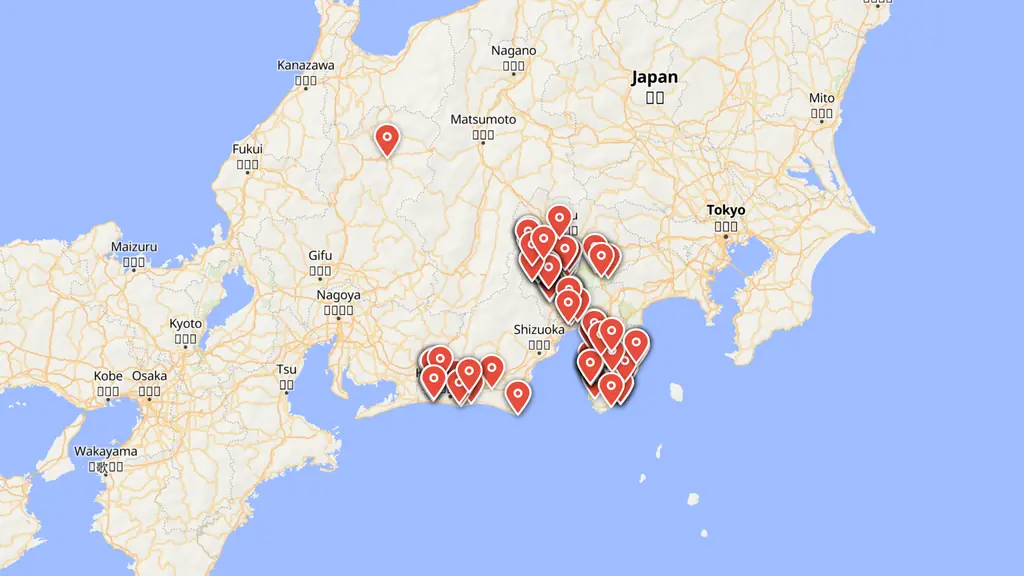
Where the scenes on the map come from
The scenes and timestamps on Anime Itinerary come from the site's own matching pipeline and from fans who visited the locations. All location data on the site is free to use, and fan submissions are no exception.
Contributions are open by email through the contribute page. A submission carries a reference screenshot, the episode and the clues that place the scene, and verified submissions are credited and added to the catalog. A signed-in form for adding scenes with their episode and timestamp is in development and not yet open.
A complete scene entry pairs a photo taken from the scene's camera position with the anime, the episode and the scene's timestamp in minutes and seconds, so the exact frame can be found again. Spring scenes are the hardest to collect, because a cherry blossom scene matches its real location for only a short window each year.
More from the spring series
This forecast guide and the anime cherry blossom spots guide open Anime Itinerary's spring coverage. More seasonal features follow as the 2027 forecasts come in.
Keep exploring
- How to plan an anime pilgrimage itinerary. Routing and pacing for a trip built around locations.
- The anime map. Every verified location in Japan, searchable by title.